


One of the most common mistakes made when planning training is focusing on just one training unit, one workout. This narrows our field of vision. We don't see training as a complex process, as the big picture, but rather as a single piece of the puzzle. Training is about skillfully selecting tools, the magnitude of stressors, and optimizing recovery throughout the training process to achieve the desired results.
The extent of the body's adaptation is multifactorial, but if a person who is new to strength training is exposed to an inappropriate and/or too high stressor, there is a significant risk that their ability to recover will be impaired for the next few days. Therefore, attempting another workout during this "window" will be ineffective. On the other hand, appropriate doses of the same workout could significantly improve training results – General Adaptation Syndrome (GAS). Using eccentric hooks in training offers a number of benefits. However, loading a beginner with a supramaximal load, despite the many advantages of this method, carries significant risks. Not only for the adaptation itself, but also for the risk of injury. In conversations with other trainers, I've heard of pectoral muscle tears during chest presses and lower back injuries during squats. This begs the question: what should you do to prepare your body for this training method? In this article, I'd like to show you my method of categorizing and prioritizing eccentric training in a long-term training process.
Let's return for a moment to a fragment of my previous article, in which I presented the relationship between the movement of the human body and the application of impulse in specific vectors. "The level of impulse and the direction in which it is applied determine both deceleration and acceleration. Therefore, impulse can be positive (acceleration) or negative (deceleration). In sports, momentum and the ability to control it are extremely important. The speed at which an athlete can accelerate and decelerate is a direct indicator of the generation and application of impulse and the control of momentum. Therefore, one could say that deceleration is a "negative" acceleration.
"The magnitude of the impulse isn't the only factor determining training success. The direction of this impulse will determine whether we accelerate or decelerate. This depends on the location of the force and the angle values during the exercise."
We already know that to improve eccentric ability, or otherwise known as the ability to absorb energy relative to the ground, we must improve impulse, both its magnitude, peak force, and rate of development. Each of these variables requires different tools (training methods). They also need to be organized into a sequence of "logical events" to ensure effective and safe training, as illustrated in my diagram.
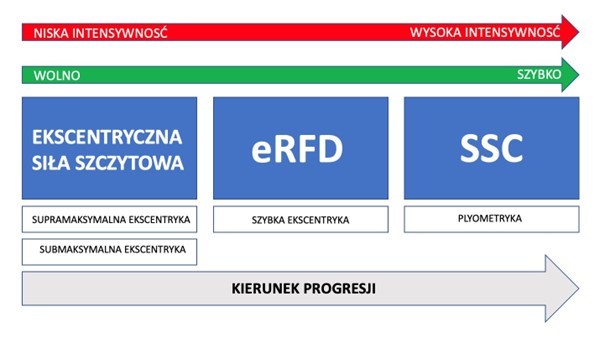
Eccentric Peak Force
Submaximal eccentricity
In reality, this isn't "pure" eccentric training; for those researching strength training, it starts with 100%+ for one-repetition maxes in the concentric range. In the literature, you'll encounter the term "tempo training." Because this method extends the eccentric phase, in some cases even up to 30 seconds (!), its intensity will decrease proportionally. Therefore, the intensity range will fluctuate between 55 and 85% of the maximum weight. I've encountered many opponents of this method, the most important, and sometimes the only, argument being the permanent "sluggishness" of the athlete. This is because by extending the negative phase of the exercise, we reduce the effectiveness of the SSC in the lower positions of the exercise. Returning to the first paragraph of this article, this method can indeed be completely useless if we use nothing else. I believe that, looking at the whole picture, it offers many benefits and can be an excellent tool for use in early GPP or, for some athletes, at the beginning of a training microcycle as part of a microdosing regimen. So why do I use it?
- Greater activation of the motor cortex occurs during eccentric muscle contraction than during concentric and isometric contractions. This indicates greater complexity of motor control during eccentric muscle actions(3)(4). It also indicates that the eccentric phase of movement is better for motor learning.
- When you “slow down” the pace of the exercise, you will improve your kinesthetic awareness as well as the stabilizing function of your muscles.
- Eccentric strengthening and a greater eccentric to concentric strength ratio reduces the risk of injury (5).
- Eccentric training increases muscle volume largely through volume gains in the distal fiber region. It increases hypertrophy by fatigue of the eccentric phase, tendons, microtendons, and ligaments. According to Brad Schoenfeld, three main factors are responsible for the hypertrophy process: muscle fiber damage, metabolic stress, and intensity. A prolonged eccentric phase will contribute to both muscle fiber damage and increased time under tension, thus increasing metabolic stress on the muscle.
- The greater the eccentric control, the greater the concentric efficiency.
- This is an early progression for supramaximal eccentricity.
Parameters and direction of progression when using submaximal methods:
Rate: 6-30s
Intensity: 55-85% CM
Repetitions: 1-5
Series: 2-5
HERE: 30s
Direction of progression:
5 reps @ 6-0-X-0 tempo
4 reps @ 8-0-X-0 tempo
3 reps @ 10-0-X-0 tempo
2 reps @ 15-0-X-0 tempo
1 rep @ 30-0-X-0 tempo
When performing the extended eccentric method, most trainees should use a weight around 80-85% of their maximum for the assigned number of reps. So, if your 5RM in the back squat is 100 kg, then for 5 reps of the extended eccentric, use 80-85 kg. However, beginners without experience in training with an accentuated eccentric phase should start with lower weights.
The time it takes for our body to "transfer" adaptations from eccentric training to achieve the desired training goal—whether improved athletic performance or progress in a given strength exercise—is 6 to 8 weeks. Therefore, using this method at the beginning of GPP is ideal.
Supramaximal eccentricity
The supra-maximal eccentric method potentiates the concentric phase by increasing muscle tension, activating type II fibers by applying a load above 100% of the trainee's capacity ("supra"). This is an advanced method and requires tissue preparation to cope with the supramaximal load.
In one study, researchers found that 1 CM could be significantly increased by using a supramaximal load (in this case, 105% of the 1 CM) during the eccentric phase of the movement. This 5% increase in eccentric phase load improved concentric 1 CM performance by 2.5-7 kg in the subjects(6).
The increase in strength following the eccentric phase results from greater stimulation of neurons within the muscles and greater accumulation of elastic energy (EE) in the muscles. Neural stimulation to the muscles during eccentric exercise causes greater stretching of the muscle spindles (muscle spindles). The muscle spindle is a "stretch" receptor in the muscle that lies parallel to the contractile proteins (actin and myosin). It responds to the magnitude and speed of stretch. The increased stretch of the muscle spindles activates the growth of motor nerves (nerves that travel to the muscles), potentially increasing the concentric contractile force in the muscle fibers (Deitz, Schmidtbleicher, & Noth, 1979).
Therefore, an excellent tool for applying this theory in practice is eccentric hooks, which are implements that we hang from both sides of the barbell to add weight to the eccentric phase. By placing additional weight on each hook, we increase the load in the desired negative phase of the exercise to potentiate the subsequent concentric phase and utilize the effect of the phenomenon described above.
Example of training using eccentric hooks: video
Parameters and direction of progression when using submaximal methods:
Beginner: 100/60
Objective: 120-140/80
Series: 2-4
HERE: 10-20s
4 reps @ 4-0-X-0 tempo
3 reps @ 6-0-X-0 tempo
2 reps @ 8-0-X-0 tempo
1 rep @ 10-0-X-0 tempo
What does the notation 100/60 mean? 100 is the percentage of the barbell weight including the hooks, and 60 is the percentage of the barbell weight after the hooks have released. Therefore, assuming the person we're training has a maximum potential of 100 kg, we have 60 kg on the barbell, and the hooks weigh 40 kg, for a total of 100 kg. When the exercise begins, the total weight is 100 kg, we begin the negative phase. At the bottom of the movement, the hooks release, leaving us with 60 kg, which we lift in the concentric phase.
FAST ECCENTRICITY
This is one of the methods necessary to shape the pace of eccentric strength development. I divide this into various forms of "catching" the weight and various forms of landings, jumps, and jumps with both feet and one foot.
Examples:
"Catching" the weight - video no. 3,4,5,6
Double-footed and single-footed landings – videos 7 and 8
The higher the exercise intensity, the smaller the "dose" needed to achieve a given stimulation. This is dictated by landing (on one or two feet) or ground contact speed (the height from which we jump). These methods should be programmed similarly to Olympic exercises.
Key benefits:
- High activation of FT fibers
- Increased stiffness
- Improved ability to convert traffic faster in SSC
PLYOMETRICS
Using plyometric exercises at the end of a training period repurposes the eccentric reserves built and transfers them to the world of sport in a truly realistic way. The number of exercises and progressions is endless; this article doesn't focus on describing this topic in detail. However, for better understanding, I've categorized the exercises based on:
- High vs. low intensity
- Long vs. short ground contact
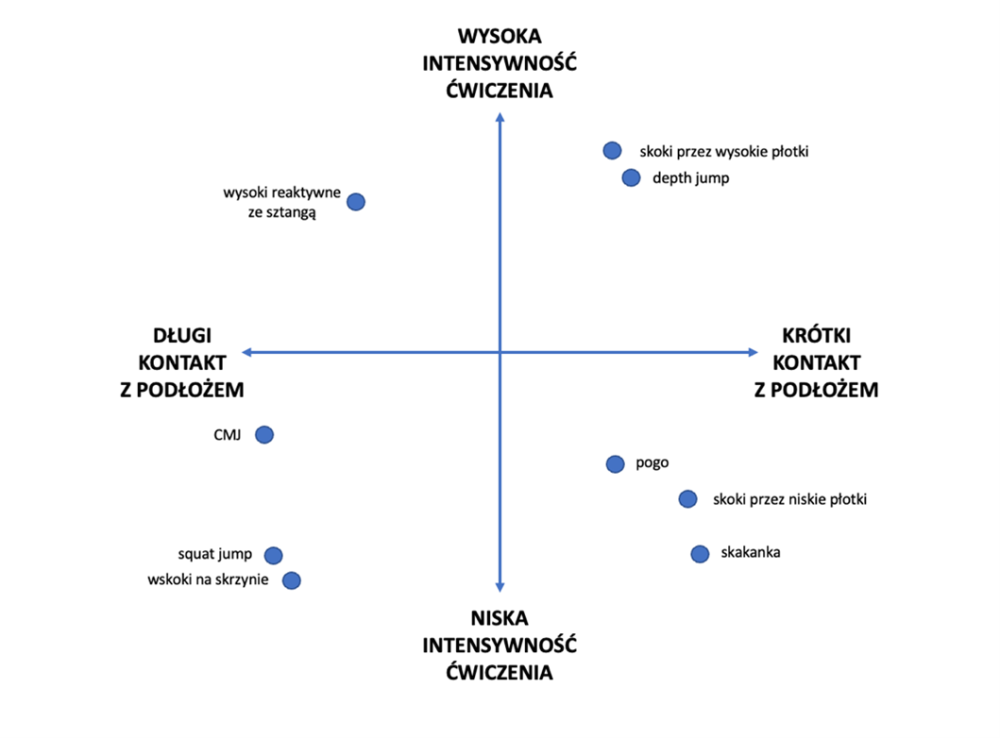
Before we choose the right methods, we also need to classify exercisers, which I divide into beginner, intermediate, and advanced. In general, for most athletes, I use the tables from the book Essentials of Strength Training and Conditioning, the original of which is included below.
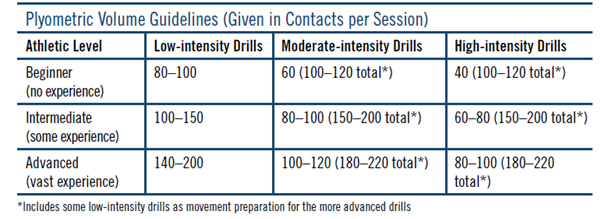
In the next article, I will present you the training plan that I use in the real world with my athletes.

Artur Pacek – Physical preparation coach. Recognized as the country's foremost specialist, he is an expert in periodization, combining training stressors, and developing muscle strength and power in team sports using three types of muscle contractions: eccentric, isometric, and concentric.
Bibliography:
-
STRESS AND THE GENERAL ADAPTATION SYNDROME BY HANS SELYE, MD, Ph.D., D.Sc., FRSC Professor and Director of the Institute of Experimental Medicine and Surgery, Universite de Montreal, Montreal, Canada
-
Application of Accentuated Eccentric Loading to Elicit Acute and Chronic Velocity and Power Improvements: A Narrative Review. Justin J. Merrigan, Jonathon Borth, Timothy J. Suchomel, etc. 2022.
-
Aging interferes with central control mechanism for eccentric muscle contraction. Wan X. Yao , et al. 2014.
-
Distinct brain activation patterns for human maximal voluntary eccentric and concentric muscle actions. Yin Fang , et al. 2004.
-
Hamstring injury occurrence in elite soccer players after preseason strength training with eccentric overload. Askling, et al.2003
-
Effects of increased eccentric loading on bench press 1RM. Doan, et al. 2002.


